Evening edition · Monday, 26 October 2026
Four delegations in Tehran, one pipeline in the desert
Saudi Arabia, Pakistan and Turkey sat down with Iran's leaders on Monday. The Houthis said they hit the East-West pipeline again. Brent eased about 1.6%, which is what a meeting is worth before anything is signed.
On Monday the defence minister of Saudi Arabia, Prince Khalid bin Salman, Pakistan’s army chief, Field Marshal Asim Munir, and Turkey’s intelligence chief, Ibrahim Kalin, met Iran’s top security officials and negotiators in Tehran1. Iranian state television showed the Pakistani delegation sitting with President Masoud Pezeshkian and Foreign Minister Abbas Araghchi2. Saudi Arabia’s deputy minister for public diplomacy, Rayed Krimly, called it part of the Makkah Defence Alliance’s efforts “for de-escalation”, in support of the mediation by Qatar and Pakistan2.
It is the first high-level contact between Iran and all three members of that alliance since Saudi Arabia was drawn deeper into the conflict2. That is the news. The rest is a list of things that have not happened yet.
What the room was for. Iran’s foreign ministry spokesman, Esmaeil Baqaei, said the “top priority” was the consequences of what Tehran calls the US-Israeli aggression2. AP reports that many Iranians are anxious about a return to all-out war, as Israeli and American leaders sharpen their threats before elections in both countries1. Four delegations in one room do not make a ceasefire. They do make a channel, and channels are dull, slow and the only thing that has ever ended a war.
What the desert did. While the delegations met, the Houthis said they had struck pumping stations on Saudi Arabia’s East-West crude pipeline and Riyadh airport; Saudi Arabia did not immediately confirm damage4. The pipeline matters because it is the route around the straits: it carries Saudi crude to the Red Sea coast. It was shut for a time in September after drone attacks on pumping stations, then resumed4. Saudi Arabia said on Sunday it had intercepted more missiles and drones3.
What the barrel said. Brent futures fell $1.90, or 1.63%, to $114.82 by 09:59 GMT, after a week in which Brent rose 6%3. CNBC had it at $115.86 by mid-morning New York time5. That is a modest discount for a meeting, on top of what one investment chief told CNBC is a risk premium of “about $20 a barrel”5. A PVM analyst put the trader’s view plainly: dips back to last week’s lows “will find grateful buyers”3.
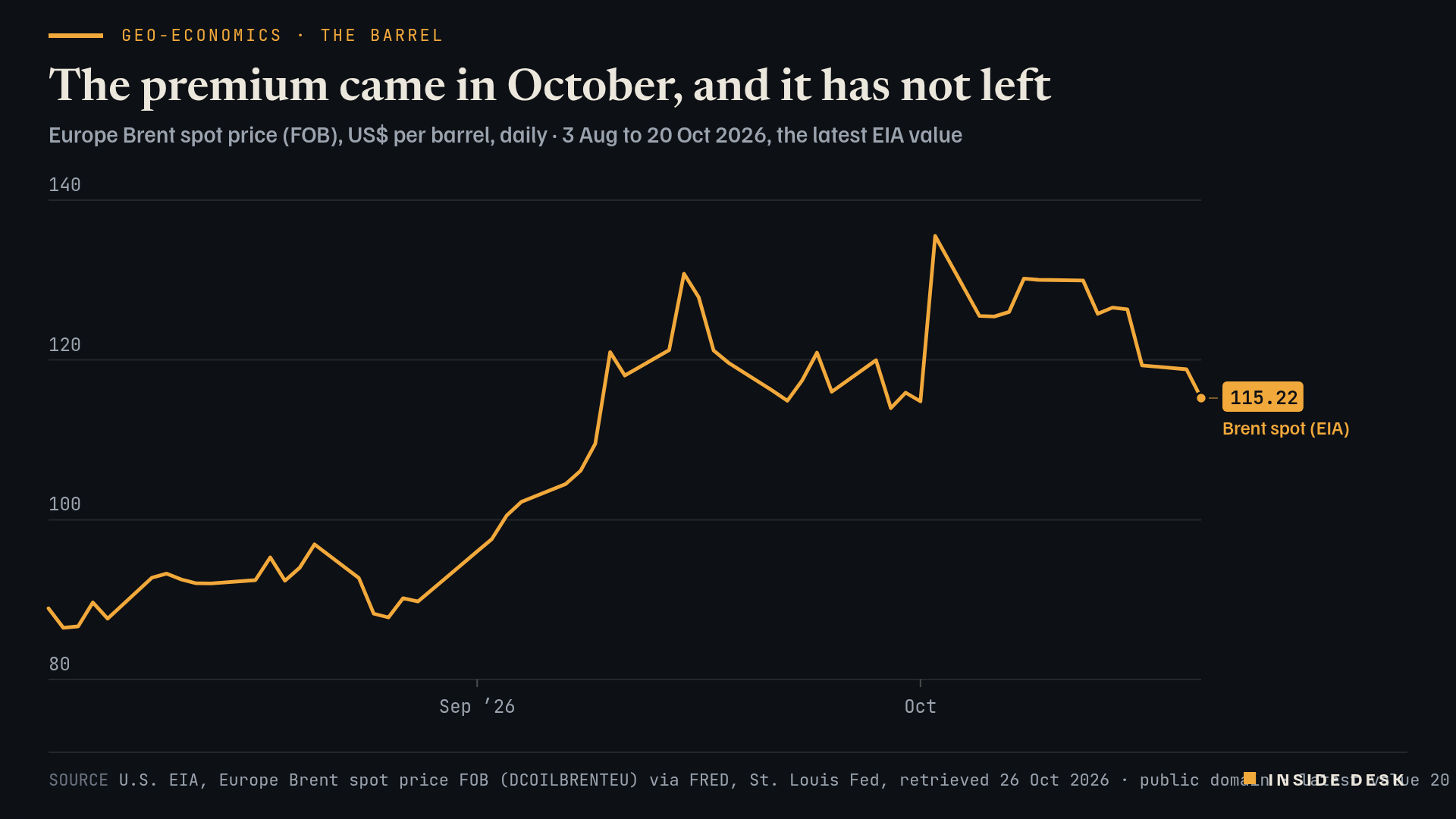
Line chart of the daily Europe Brent spot price from 3 August to 20 October 2026, in US dollars per barrel. It starts at $88.90 on 3 August, with the period low of $86.47 on 4 August, climbs through September to a peak of $135.51 on 2 October, and stands at $115.22 on 20 October, the latest value published by the EIA. Futures prices quoted on 26 October are not part of this series.
Source U.S. EIA, Europe Brent spot price FOB (DCOILBRENTEU) via FRED, St. Louis Fed, retrieved 26 Oct 2026 · public domain · latest value 20 Oct 2026. EIA spot prices via FRED, Federal Reserve Bank of St. Louis. U.S. government data, public domain.
Data (CSV) · SVG · PNG

Latest values as a table
| Date | Brent spot (EIA) |
|---|---|
| 2026-10-13 | 125.78 |
| 2026-10-14 | 126.55 |
| 2026-10-15 | 126.35 |
| 2026-10-16 | 119.33 |
| 2026-10-19 | 118.82 |
| 2026-10-20 | 115.22 |
What the official series says. The EIA’s daily Brent spot price, the public-domain record, peaked at $135.51 on 2 October and stood at $115.22 on 20 October, its latest published value6. It lags the futures by several days, so read the chart as the shape of the autumn, not as today’s price. The shape is the point: the premium arrived in late September and has eased, not disappeared.
The ledger view. Saudi Arabia also said on Monday it will start storing crude in Singapore from the second half of 20275. That is not a headline about war. It is a headline about inventory, which is what serious people do when they expect the next disruption to be ordinary. Storage contracts, pipeline repairs and insurance policies outlast speeches. So, usually, do the meetings that produce nothing on the first day.
Nothing here is investment advice.
What to watch
- Whether anything written comes out of Tehran: a joint statement, a date for a further round, a named channel to Washington2.
- Saudi confirmation, or not, of damage at the pumping stations; the pipeline was shut for a time in September4.
- The EIA's next spot prices; the series currently ends on 20 October6.
A meeting is a promise to keep talking. Markets price the promise at about two dollars. They will price the paperwork properly when there is some.
Sources
- Delegations meet in Iran with Mideast region on edge over potential for renewed fighting — AP, 26 Oct 2026.
- Talks with Makkah pact countries begin in Tehran: Iranian state media — Dawn (Reuters, AFP), 26 Oct 2026, 18:32 PKT.
- Oil slips but stays near six-month highs on Saudi attacks — Business Recorder (Reuters), 26 Oct 2026, 0959 GMT.
- Houthis say they attacked East-West oil pumping stations; no Saudi confirmation — Al-Monitor (Reuters), 26 Oct 2026.
- Oil prices fall as Saudi defense minister travels to Iran for talks — CNBC, 26 Oct 2026, 9:19 a.m. ET.
- Crude Oil Prices: Brent - Europe (DCOILBRENTEU) — U.S. EIA via FRED, retrieved 26 Oct 2026.
Every figure in this piece traces to a source above or to the desk’s own arithmetic on those sources, marked as such. Quotations are short and attributed. Spot an error? Write to the desk; corrections are logged on the method page.
Commentary for information only. Not investment, legal, tax, medical or political advice. Not an offer or solicitation. Analysis may be incomplete or wrong. Charts show published public data, not a trading feed; binding numbers live with the institutions that publish them.