Morning edition · Thursday, 22 October 2026
Podium vs Print: "quite close to 2%" depends on the ruler
A Bank of Japan deputy governor told parliament that underlying inflation is quite close to target, and argued for more rate rises. The bank's own six staff measures for August run from 1.3% to 2.6%. He is right on average, and the average is the argument.
“…underlying inflation is quite close to 2% and will likely converge to levels consistent with our price target.”
Ryozo Himino, Deputy Governor, Bank of Japan, in parliament, 21 October 2026
1.3% to 2.6%
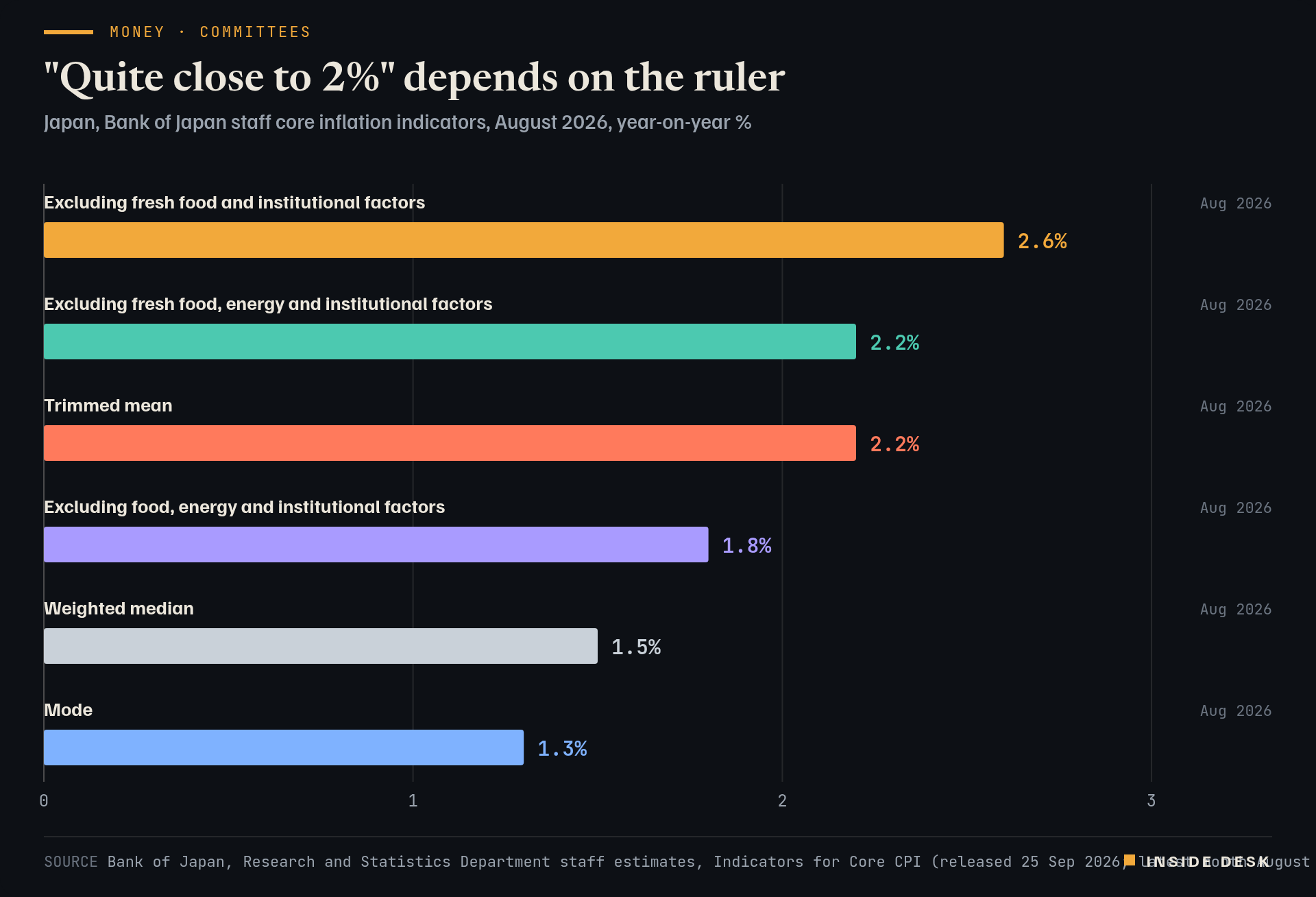
The bank's six staff measures of underlying inflation for August 2026, from a mode of 1.3% to 2.6% excluding fresh food and institutional factors.
Bank of Japan, Research and Statistics Department staff estimates, Indicators for Core CPI, August 2026 (released 25 September 2026, latest available)
The podium. On Wednesday Ryozo Himino, a deputy governor of the Bank of Japan, told parliament that “underlying inflation is quite close to 2% and will likely converge to levels consistent with our price target”1. He added that financial conditions “remain accommodative” even after last month’s rate rise, and that “delaying necessary adjustment to monetary support” could let inflation risks materialise1. In plain words: more rises are coming, and the case rests on that one phrase about underlying inflation.
The print. “Underlying” is not one number. The bank’s own research staff publish six measures that strip out different kinds of noise, from fresh food and energy to policy effects such as subsidies and free school lunches2. For August, the latest month available, they range from 1.3% to 2.6%2:
Bar chart of six Bank of Japan staff measures of underlying inflation for August 2026, year on year: excluding fresh food and institutional factors 2.6%; excluding fresh food, energy and institutional factors 2.2%; trimmed mean 2.2%; excluding food, energy and institutional factors 1.8%; weighted median 1.5%; mode 1.3%. Three are at or above 2.2%, three below 2%; the target is 2%.
Source Bank of Japan, Research and Statistics Department staff estimates, Indicators for Core CPI (released 25 Sep 2026; latest month August 2026). Trimmed mean 2.16% and weighted median 1.54% rounded by the desk. Figures as reported by the named organisations; facts cited with attribution.
Data (CSV) · SVG · PNG

Latest values as a table
| Value | |
|---|---|
| Excluding fresh food and institutional factors | 2.6% |
| Excluding fresh food, energy and institutional factors | 2.2% |
| Trimmed mean | 2.2% |
| Excluding food, energy and institutional factors | 1.8% |
| Weighted median | 1.5% |
| Mode | 1.3% |
The broad measures, which exclude fresh food and institutional factors, sit at 2.6% and, without energy, 2.2%2. The trimmed mean, which drops the most extreme price changes at both ends, is 2.2%2. The narrower measures are lower: 1.8% excluding all food and energy, a weighted median of 1.5% and a mode of 1.3%2. The trend is rising, though. The trimmed mean was 1.7% in May and has gone up each month since2.
The gap. Desk arithmetic: the simple average of the six is 1.93%, which is indeed “quite close to 2%”. But three measures are at or above 2.2% and three are below 2%, and the low ones describe the typical price change, not the loud ones. Himino’s other argument is about pressure still to come: fuel and raw material costs, and “brisk global AI demand” boosting exports and investment1. The trade print released the same morning complicates that. September exports were up 16.7% on a year earlier, well short of the 20.1% analysts had expected, the second monthly slowdown in a row, although chip shipments rose 49.4%3.
Verdict. The podium is fair about the middle and quiet about the spread. That is not a trick; it is what a committee does when it has to reduce six rulers to one decision. For you, the useful habit is to look at which ruler a speaker picks. A central bank that wants to keep raising rates will point at the measures above 2%, and the ones below 2% will be the first thing it is asked about if the next prints soften. Nothing here is advice.
What to watch
An average is a verdict that the parts have not yet signed.
Sources
- BOJ's Himino signals readiness to raise borrowing costs — Reuters via Investing.com, 21 Oct 2026.
- Indicators for Core CPI (research data, XLSX) — Bank of Japan, released 25 Sep 2026, retrieved 22 Oct 2026.
- Japan exports post huge miss in September as growth slows to 16.7% — CNBC, 20 Oct 2026, 19:53 EDT.
Every figure in this piece traces to a source above or to the desk’s own arithmetic on those sources, marked as such. Quotations are short and attributed. Spot an error? Write to the desk; corrections are logged on the method page.
Commentary for information only. Not investment, legal, tax, medical or political advice. Not an offer or solicitation. Analysis may be incomplete or wrong. Charts show published public data, not a trading feed; binding numbers live with the institutions that publish them.