Morning edition · Wednesday, 25 November 2026
4.9% in Australia, 0.21% for America: the base year votes first
Two inflation prints on one Wednesday, and both are partly about last year. The committees in Washington and Frankfurt are already leaning the same way.
Australia’s consumer prices rose 4.9% in the twelve months to October, up from 4.3% in September, the Australian Bureau of Statistics said overnight1. At 14:30 CET today America publishes its own October number, the personal consumption expenditures price index, the gauge by which the Federal Reserve judges its 2% goal3. Forecasters expect the annual rate to rise to about 3.8% from 3.6%, and the core rate, without food and energy, to about 3.2% from 3.1%2.
Two prints, two continents, one shared lesson that rarely makes the headline: a good part of both numbers was decided a year ago.
Australia: the rebate that ended. Electricity prices in Australia rose 25.2% in the year to October, up from 12.8% in September1. The statistician’s explanation is plain: Commonwealth government rebates “reduced household electricity costs last year but are no longer in place,” said Rachael McCririck, the ABS head of price statistics1. Housing as a whole rose 6.4%, transport 10.6%, and automotive fuel 6.3% in October alone, “driven by higher world oil prices”1.
That mixes two kinds of inflation. Fuel is the world arriving at the pump. Electricity is partly a policy decision from last year arriving on this year’s bill. The measure designed to look through such swings, the trimmed mean, rose to 3.8% from 3.6%1. Lower than the headline, yes, but still rising.
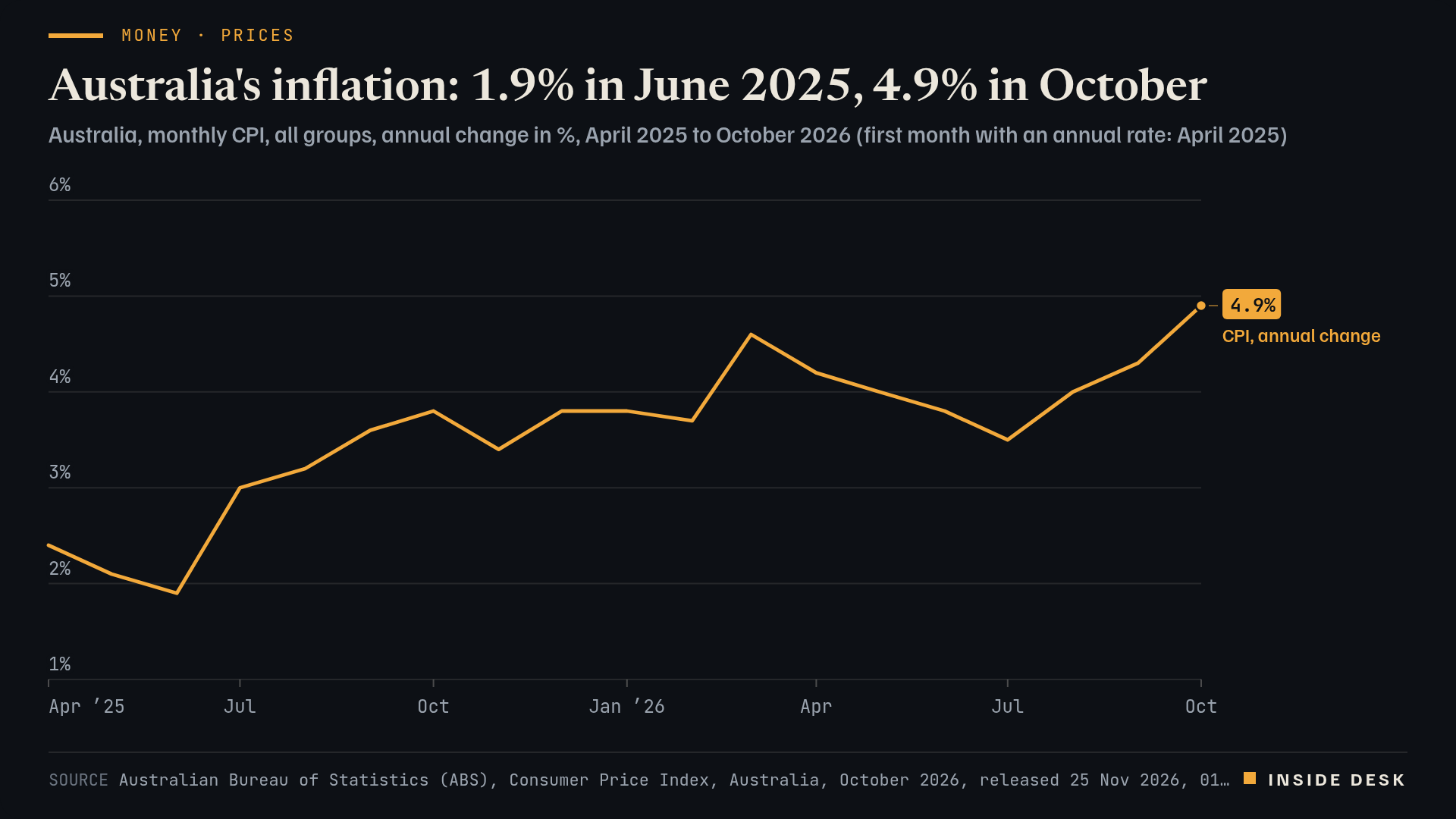
Line chart of Australia's monthly consumer price index, annual change in percent, from April 2025 to October 2026. Inflation was 2.4 percent in April 2025, fell to a low of 1.9 percent in June 2025, rose to 3.8 percent by October 2025, peaked at 4.6 percent in March 2026, eased to 3.5 percent in July 2026 and has since risen to 4.0 percent in August, 4.3 percent in September and 4.9 percent in October 2026, the latest month.
Source Australian Bureau of Statistics (ABS), Consumer Price Index, Australia, October 2026, released 25 Nov 2026, 01:30 CET; retrieved 25 Nov 2026 · source: ABS. Figures as reported by the named organisations; facts cited with attribution.
Data (CSV) · SVG · PNG

Latest values as a table
| Date | CPI, annual change |
|---|---|
| 2026-05-01 | 4 |
| 2026-06-01 | 3.8 |
| 2026-07-01 | 3.5 |
| 2026-08-01 | 4 |
| 2026-09-01 | 4.3 |
| 2026-10-01 | 4.9 |
The chart shows why a single month misleads in both directions. Annual inflation was 1.9% in June 2025, 4.6% in March 2026, 3.5% in July and 4.9% now1. The line did not climb steadily; it was pushed, released and pushed again, partly by oil and partly by the calendar of public subsidies.
America: the small October. The US number has its own base effect. Last October, core PCE prices rose only about 0.18% in the month. That means a rise of about 0.21% this October is enough to lift the published annual core rate from 3.1% to 3.2%, StockTitan’s preview notes3. Core prices have cleared that bar in seven of the nine months of 20263. Monthly forecasts cluster near 0.3%2.
There is a second quirk. October’s consumer price index was published without an annual rate, because price collection was disrupted during the 2025 government shutdown and left no year-ago base2. So today’s PCE report is the only year-on-year inflation measure for October2. One number has to carry the weight that two usually share.
The committees have already leaned. Fed funds futures price a 97% chance of a rate rise on 9 December, and a 66% chance of another in January, according to CME Group’s FedWatch tool as cited by Reuters4. The Fed’s target range is 3.75% to 4.00% after a rise in September and a hold in October2.
At the ECB the language is less exact but points the same way. “We are really taking a meeting-by-meeting approach,” the Dutch central bank governor Olaf Sleijpen said on Tuesday. “But let’s put it this way: I think the direction is clear”5. Germany’s Joachim Nagel has said the ECB would likely have to tighten next month5. And at Thursday’s EU summit, European Council president António Costa aims to begin consulting the European Parliament and the ECB’s Governing Council on Christine Lagarde’s successor; the two candidates are Pablo Hernández de Cos and Klaas Knot6.
What to take from it. When an annual inflation rate jumps, ask two questions before you ask what the central bank will do. First: what dropped out of the window, a cheap month or a subsidy? Second: what came in, a world price or a domestic one? Australia’s October answers both: an expired rebate and a dearer barrel. America’s October will be read mostly through a small base.
Neither question makes inflation harmless. A rebate that ends is a real cost to the household that pays the bill, and a base effect still lifts the number the committee is judged by. But the questions tell you how much of the rise belongs to this year. That is the part a rate rise can lean against.
The speeches will come after 14:30. The arithmetic was already there on Tuesday night.
What to watch
- The US October PCE report at 14:30 CET today, published together with the second estimate of third-quarter GDP2,3.
- The Fed's decision on 9 December, with a quarter-point rise priced at 97% and a further rise in January at 66%4.
- Thursday's EU summit, where consultations on Christine Lagarde's successor are due to begin; the two candidates are Pablo Hernández de Cos and Klaas Knot6.
An annual rate is a twelve-month window. Before you read what came in, look at what went out.
Sources
- CPI rose 4.9% in the year to October 2026 — Australian Bureau of Statistics, 25 Nov 2026, 11:30 AEDT (01:30 CET).
- US PCE preview: inflation seen near 3.8% in the Fed's last read before a December hike — investingLive, 24 Nov 2026.
- PCE Inflation Report Wednesday Is the Last Major Inflation Release Before the Fed's December 9 Decision — StockTitan, 23 Nov 2026.
- Nasdaq, S&P 500 close lower, giving up some Nvidia-fueled gains — NBC News (Reuters), 24 Nov 2026, 23:56 CET.
- ECB policy direction clear for December but uncertain after, Sleijpen says — Reuters via Investing.com, 24 Nov 2026.
- France and Germany near deal on De Cos for ECB top job as EU confirms two candidates — Euronews, 13 Nov 2026.
Every figure in this piece traces to a source above or to the desk’s own arithmetic on those sources, marked as such. Quotations are short and attributed. Spot an error? Write to the desk; corrections are logged on the method page.
Commentary for information only. Not investment, legal, tax, medical or political advice. Not an offer or solicitation. Analysis may be incomplete or wrong. Charts show published public data, not a trading feed; binding numbers live with the institutions that publish them.