Evening edition · Monday, 23 November 2026
€210.46 billion to borrow, €1.8 billion nobody will sign for: budget week opens
Söder's cold-progression push met a wall of CDU premiers on Monday. The quarrel is about less than 1% of the borrowing, and about who signs the cheque.
This morning Markus Söder had a podium: cold progression, he said on Sunday, must be adjusted “urgently”. By lunchtime he had a reply, and it came from his own side of the table. “Cold progression was simply not the instrument of choice,” Hendrik Wüst, the CDU premier of North Rhine-Westphalia, told ZDF; the coalition committee, which Söder attended, had chosen the electricity-tax cut instead, “even if we would all wish for more”1. Gordon Schnieder, the CDU premier of Rhineland-Palatinate, called the demand “simply not serious if you don’t say honestly how it is to be financed”1. The finance ministry noted “very, very different” responses from the Länder and called it, in effect, a discussion among the Länder1. (Quotes translated.)
That is how budget week begins. From Tuesday the Bundestag debates the 2027 federal budget in second reading; on Friday at 12:40 the third reading starts, and after 90 minutes of debate comes the vote2.
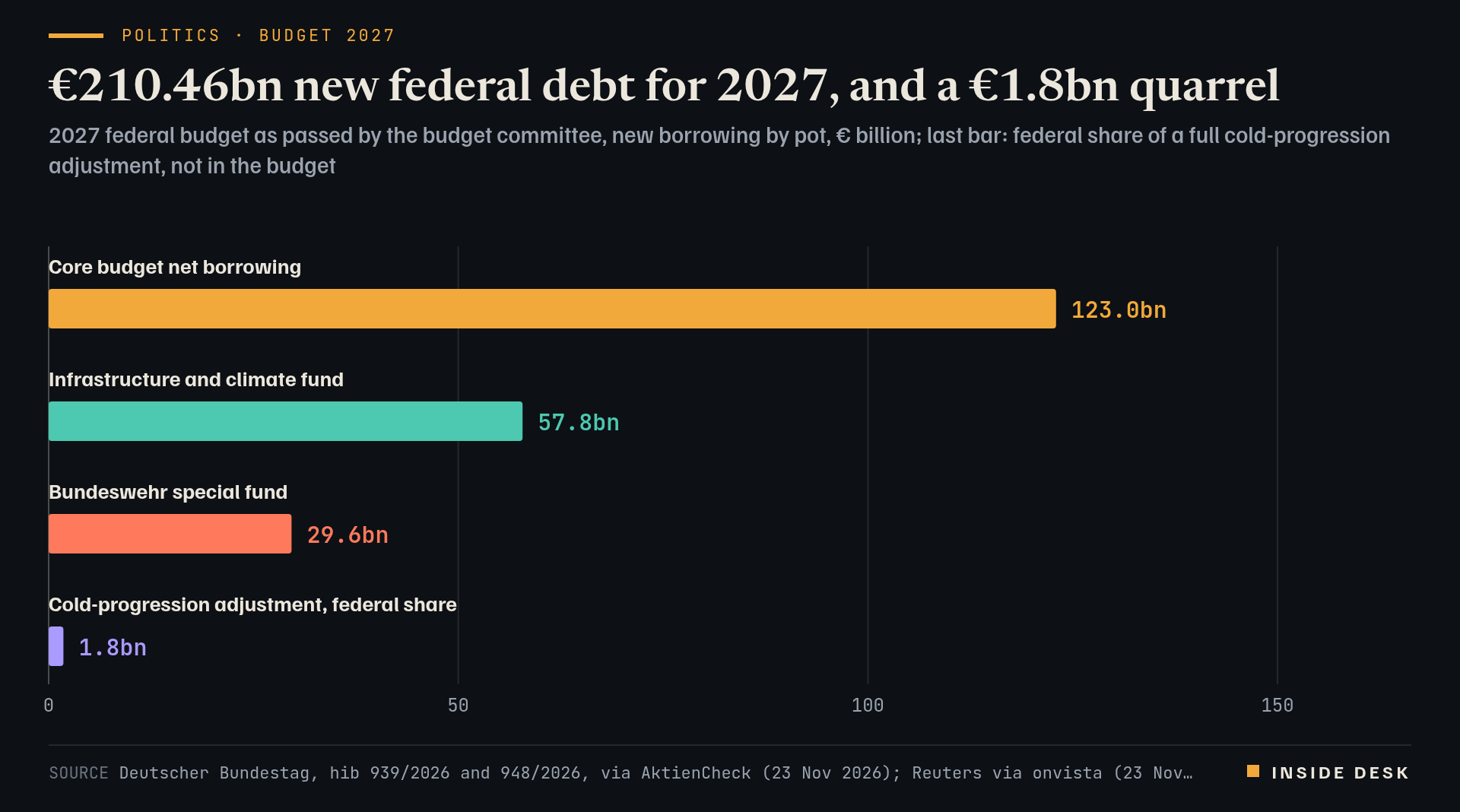
The size of the thing. Core spending is €560.92 billion, 6.9% more than the €524.54 billion planned for 20262. Net borrowing in the core budget rises from €97.96 billion to €122.97 billion. Add the two special funds, €57.84 billion for infrastructure and climate neutrality and €29.65 billion for the Bundeswehr, and new borrowing comes to €210.46 billion, according to the Bundestag’s own press service as cited by AktienCheck2. Of the core borrowing, €84.55 billion falls under the exemption for defence and security; the €38.43 billion that counts against the debt brake sits, in the press service’s words, “exactly at the ceiling”2.
Bar chart of planned new federal borrowing in Germany for 2027 as passed by the Bundestag budget committee: 122.97 billion euros in the core budget, 57.84 billion in the special fund for infrastructure and climate neutrality and 29.65 billion in the Bundeswehr special fund, together 210.46 billion euros. A fourth, much smaller bar shows about 1.8 billion euros, the federal government's reported share of the cost of a full adjustment for cold progression in 2027, which is not in the budget.
Source Deutscher Bundestag, hib 939/2026 and 948/2026, via AktienCheck (23 Nov 2026); Reuters via onvista (23 Nov 2026) · reported figures. Figures as reported by the named organisations; facts cited with attribution.
Data (CSV) · SVG · PNG

Latest values as a table
| Value | |
|---|---|
| Core budget net borrowing | 122.97bn |
| Infrastructure and climate fund | 57.84bn |
| Bundeswehr special fund | 29.65bn |
| Cold-progression adjustment, federal share | 1.8bn |
The size of the quarrel. A full cold-progression adjustment would cost the federal government and the Länder about €1.8 billion each next year and the municipalities about €400 million, Reuters reports; Berlin refuses to carry all three shares, and only Bavaria and Hessen have offered to pay theirs1. Desk arithmetic: the federal €1.8 billion is about 0.9% of the €210.46 billion the federal government plans to borrow. It is not the amount that is hard. It is that the debt-brake part of the budget is already full, so every new euro of relief needs a euro found somewhere else, and the electricity-tax cut was where the coalition chose to spend its euro1,2.
That cut is not free either. It takes the tax on household and business power from 2.05 to 0.1 cents a kilowatt hour for 2027 only, at a cost of €5.4 billion, paid from unneeded money on the renewables (EEG) account; if that account runs short, the coalition has promised a package of measures, from cutting subsidies to raising other taxes3. For 2028 the plan already shows a gap of about €25 billion, which a permanent cut would widen to about €30 billion3.
What you can actually watch. The interesting part of this week is not Wednesday’s general debate, however lively ZDF expects it to be4. It is the paperwork: whether the electricity-tax cut, agreed after the budget committee had finished, is written into the budget before Friday’s vote, as it has to be3; and whether any Land other than Bavaria and Hessen puts a number next to its name for cold progression1. A demand with a financing line is a policy. Without one, as Schnieder put it, it is a speech1.
The calm reading is not that Germany cannot afford €1.8 billion. It is that a budget at its ceiling forces politicians to rank their promises, in public, with numbers attached. That is uncomfortable for a party leader on a Sunday. It is exactly what a parliament is for on a Friday.
What to watch
- Second reading of the 2027 budget from Tuesday; the general debate is traditionally on Wednesday morning2,4.
- Third reading on Friday 27 November from 12:40, 90 minutes of debate, then the final vote on the budget and its accompanying law2.
- Whether the electricity-tax cut agreed on 17 November is written into the budget text before Friday, as tagesschau reports it must be3.
A budget is a list of promises with a column for who pays. Read the column.
Sources
- CDU-Ministerpräsidenten und Bund bremsen Söders neusten Steuer-Vorstoß — Reuters via onvista, 23 Nov 2026, 13:14 CET.
- Bundeshaushalt 2027: Haushaltswoche startet mit 210,46 Milliarden Euro Neuverschuldung — AktienCheck (citing Bundestag hib 939/2026 and 948/2026), 23 Nov 2026, 09:40 CET.
- Stromsteuersenkung und Spritpreisdeckel: Was die Entlastungen im Alltag bringen könnten — tagesschau.de, 18 Nov 2026, 14:36 CET.
- Update am Morgen: Um so viel Geld ging es im Bundestag noch nie — ZDFheute, 23 Nov 2026, 06:45 CET.
Every figure in this piece traces to a source above or to the desk’s own arithmetic on those sources, marked as such. Quotations are short and attributed. Spot an error? Write to the desk; corrections are logged on the method page.
Commentary for information only. Not investment, legal, tax, medical or political advice. Not an offer or solicitation. Analysis may be incomplete or wrong. Charts show published public data, not a trading feed; binding numbers live with the institutions that publish them.