Sunday long-read · Sunday, 22 November 2026
The Sunday long read: Ten per cent off the Nasdaq in a week, and $81 billion still waiting to be paid
The worst week since April 2025 was told in tickers, short reports and a fear gauge near 36. The documents underneath it, from Nvidia's balance sheet to Friday's rush into government bonds, tell a slower and more useful story.
You did not need a terminal to know how the week went. You only needed to hear someone say “AI” in a worried voice. By Friday night the Nasdaq Composite had fallen 5.28% in a single session to 22,617.73, the S&P 500 3.70% to 6,910.39 and the Dow 949.73 points, or 1.93%, to 48,147.331,4. The S&P 500 and the Dow both closed more than 10% below their records, the textbook line for a correction, and the Nasdaq turned negative for the year, down 2.7%1.
A note for readers of Friday evening’s ePaper: its last update, stamped 22:02 CET, carried a Nasdaq fall of 4.81%; the settled close, reported later by CNBC and Reuters, was 5.28%1,4. The first number is rarely the final one.
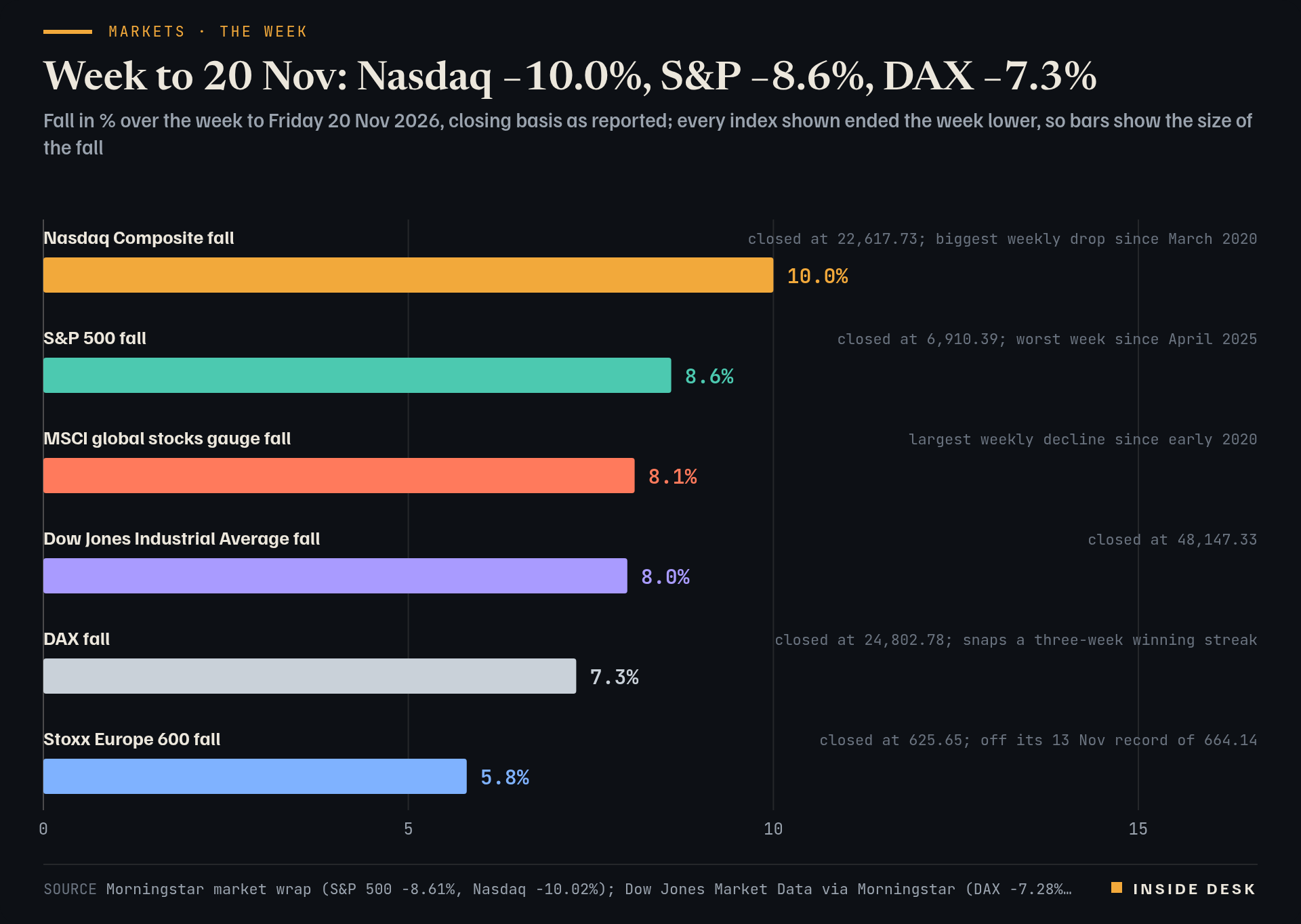
The week, in one picture. Over five sessions the Nasdaq lost 10.02% and the S&P 500 8.61%, Morningstar calculated2; the Dow lost 8%1. CNBC called it the Dow’s worst week since March 2020 and the S&P 500’s worst since the tariff shock of April 20251. Europe did not escape: the DAX fell 7.28% to 24,802.78, its biggest weekly percentage loss since the week ending 4 April 20255, and the Stoxx Europe 600 5.80% to 625.656. MSCI’s gauge of stocks across the globe fell 8.1%, its largest weekly decline since early 20204.
Bar chart of weekly falls in the week to Friday 20 November 2026, all indexes lower: the Nasdaq Composite fell 10.0 percent to 22,617.73, the S&P 500 8.6 percent to 6,910.39, MSCI's gauge of stocks across the globe 8.1 percent, the Dow Jones Industrial Average 8.0 percent to 48,147.33, Germany's DAX 7.3 percent to 24,802.78 and the Stoxx Europe 600 5.8 percent to 625.65. Bars show the size of the fall.
Source Morningstar market wrap (S&P 500 −8.61%, Nasdaq −10.02%); Dow Jones Market Data via Morningstar (DAX −7.28%, Stoxx 600 −5.80%); CNBC and Investopedia (Dow −8%); Reuters (MSCI world −8.1%, closes); all 20 Nov 2026, retrieved 22 Nov 2026 · reported figures. Figures as reported by the named organisations; facts cited with attribution.
Data (CSV) · SVG · PNG

Latest values as a table
| Value | |
|---|---|
| Nasdaq Composite fall | 10% |
| S&P 500 fall | 8.6% |
| MSCI global stocks gauge fall | 8.1% |
| Dow Jones Industrial Average fall | 8% |
| DAX fall | 7.3% |
| Stoxx Europe 600 fall | 5.8% |
Read the chart from the bottom up, not the top down. The further a market sits from the chips, the shorter its bar. The Stoxx 600, heavy with banks, insurers and food companies, lost the least. Even after this week it is up 5.65% for the year6, and the DAX is still up 1.28%5. The year’s gains have shrunk. In Europe they have not gone.
What was actually sold. This was not a general verdict on the economy. Morningstar’s sector table for the US market shows technology down 11.98% for the week and consumer defensives down 2.03%2. On Friday consumer staples was the only S&P 500 sector to finish higher4. The Philadelphia chip index fell 10.7% on Friday and 17.1% over the week4. Nvidia fell 14% on Friday and more than 20% over the week, AFP reported9; AMD lost 13% on Friday3, the day after a short seller’s report.
That report deserves a careful sentence, because careful sentences were scarce. On Thursday Hunterbrook Media, which disclosed a short position, alleged that AMD has “its own China problem”; the shares closed down 7.72% at $489.198. AMD replied that the claims “misrepresent AMD’s business practices and relationships” and said it complies with US export controls8. CNBC said it had not independently verified the allegations8. Neither have we. A short report is a case argued by someone who profits if you agree with it. A company statement is a case argued by someone who profits if you don’t. Both belong in the file. Neither is the verdict.
Then came the regulators. On Friday Reuters reported, citing sources, that the Securities and Exchange Commission’s probe into Nvidia is examining possible accounting issues1; on Saturday The New York Times reported that the inquiry is in its early stages, AFP summarised, adding that the probe could end without any charges9. Also on Friday, President Trump said he “would love to see Jensen be given a second chance”; Nvidia’s chairman Harvey Jones has ruled out a return for the former chief executive9. Hold those as what they are: reports and wishes, not findings.
The invoice that came first. Strip away the week’s noise and one document stands taller than all the rest. On Tuesday Nvidia reported third-quarter revenue of $115.8 billion, up 103% on a year earlier, with $107.6 billion from data centres and net income of $65.3 billion7. It guided to $130 billion, plus or minus 3%, for the fourth quarter, which includes an extra week, and it is assuming no data-centre compute revenue from China7. Investopedia’s verdict on the week was blunt: Nvidia and Anthropic “delivered on their end”, and it still was not enough3.
That sounds like a paradox. It is not, once you open the balance sheet rather than the headline. On 25 October Nvidia’s accounts receivable stood at $81.0 billion, against $38.5 billion on 25 January; inventories were $39.7 billion, against $21.4 billion7. Desk arithmetic: receivables have risen about 111% in nine months and inventories about 86%; receivables now equal about 70% of one quarter’s revenue.
None of that is a warning sign by itself. A company growing this fast sends more invoices and holds more parts, and the same release reports that its Vera Rubin NVL72 systems have shipped7. But it tells you where the story now lives. Revenue is recorded when the goods are delivered and invoiced. Cash arrives when the customer pays. The question for the coming quarters is not whether the demand was real on paper. It is whether the paper turns into cash at the speed it was promised. That question is answered by accounts departments, not by keynote speeches, and it will be answered in the next 10-Q, not on the next trading day.
The listing that worked, and the price that didn’t. Anthropic’s flotation was the other set piece. The company sold 980 million shares at $83, above its first $70–78 range, opened at $111.50 and closed its debut at about $973. On Friday it fell 9.1% to $88.304. Desk arithmetic: that is still about 6% above the offer price. The company raised its money. Some of the people who bought at the open lost theirs. Both statements are true, and only the first matters to the company’s ability to pay its bills.
Where the money went. Money that leaves shares has to sit somewhere, and on Friday it sat in government bonds. The US 10-year yield fell 10.43 basis points to 4.948%, its biggest daily drop since 22 October4. Gold, oddly, was no shelter: spot gold fell to a 14-month low of $3,520.09 an ounce4. The VIX, the price of insurance against a falling S&P 500, closed near 36, its highest close since April 20253,4. “Markets are entering a more defensive phase,” said Daniela Hathorn of Capital.com4. Courtney Garcia of Payne Capital Management called it “much more of a pullback in a longer-term bull market” than the start of a recession3. Note that both are descriptions, not dates.
What to keep, and what to drop. Drop the idea that a week like this tells you whether AI is real. Revenue of $115.8 billion in one quarter is real7; so is a short report, so is a regulator asking questions, and so is a Fed hike priced for December4. They answer different questions. Keep the habit that weeks like this reward: read the receivables line before the share price, and the cash flow statement before the commentary. Panic and hype share one weakness. Both are in a hurry. The invoices are not.
Nothing here is investment advice.
What to watch
- A short US week: traders were already buying crude ahead of next week's Thanksgiving holiday on Friday, Reuters noted4; US stock markets close on Thursday 26 November.
- The Federal Reserve's December meeting: a rate hike was still priced in for it on Friday even as the two-year Treasury yield fell 13.21 basis points to 4.647%, according to Reuters4.
- Nvidia's next dividend of $0.25 a share, to holders of record on 2 December and paid on 23 December, per the company7.
A share price is a vote. A receivable is a promise. The week counted the votes; the next quarters will count the promises.
Sources
- S&P 500 and Dow close in correction; Nasdaq erases 2026 gain as AI rout picks up steam — CNBC, 20 Nov 2026, updated 18:46 EST (00:46 CET 21 Nov).
- Market Wrap: Stocks Lose 8.51% as Technology and Basic Materials Fall — Morningstar, 20 Nov 2026.
- Markets News, Nov. 20, 2026: Major Stock Indexes Sink, Wipe Out 2026 Gains as AI Trade Melts Down — Investopedia, 20 Nov 2026, updated 17:57 EST (23:57 CET).
- Tech leads global stocks rout, Treasury yields fall — Reuters, 20 Nov 2026 (updated).
- DAX Ends the Week 7.28% Lower at 24802.78 — Data Talk — Dow Jones Market Data via Morningstar, 20 Nov 2026.
- STOXX Europe 600 Index Ends the Week 5.80% Lower at 625.65 — Data Talk — Dow Jones Market Data via Morningstar, 20 Nov 2026.
- NVIDIA Announces Financial Results for Third Quarter Fiscal 2027 — NVIDIA (press release), 17 Nov 2026.
- AMD dives on short seller report of alleged China exposure — CNBC, 19 Nov 2026, updated 19:08 EST (01:08 CET 20 Nov).
- Nvidia faces US accounting probe amid deepening turmoil: media — AFP via France 24, 21 Nov 2026, 22:56 CET.
Every figure in this piece traces to a source above or to the desk’s own arithmetic on those sources, marked as such. Quotations are short and attributed. Spot an error? Write to the desk; corrections are logged on the method page.
Commentary for information only. Not investment, legal, tax, medical or political advice. Not an offer or solicitation. Analysis may be incomplete or wrong. Charts show published public data, not a trading feed; binding numbers live with the institutions that publish them.