Morning edition · Friday, 20 November 2026
8.1% at the factory gate, 97.2% for heating oil: Germany's producers pay the war's invoice first
Producer prices rose at their fastest pace since early 2023. Strip out energy and the figure is 3.6%: still too warm, but a different problem.
German producer prices of industrial products were 8.1% higher in October 2026 than a year earlier, Destatis reported on Friday morning1. It is the steepest annual rise since February 2023, when the figure was 13.9%, and prices rose 1.4% from September alone1.
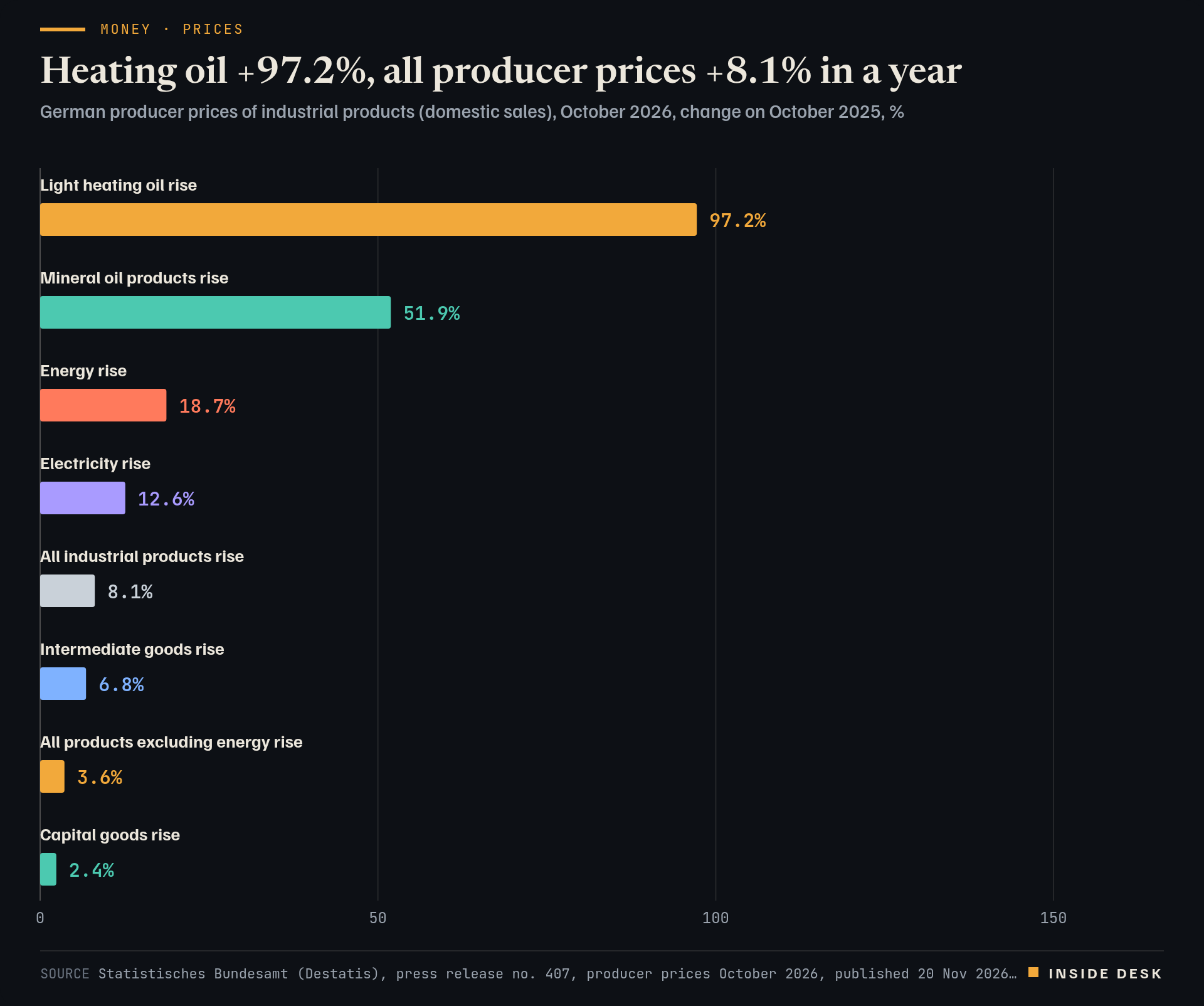
Bar chart of the change in German producer prices of industrial products between October 2025 and October 2026, per Destatis: light heating oil up 97.2 percent, mineral oil products up 51.9 percent, energy up 18.7 percent, electricity up 12.6 percent, all industrial products up 8.1 percent, intermediate goods up 6.8 percent, all products excluding energy up 3.6 percent and capital goods up 2.4 percent. Non-durable consumer goods, not shown, were 1.3 percent cheaper.
Source Statistisches Bundesamt (Destatis), press release no. 407, producer prices October 2026, published 20 Nov 2026, 08:00 CET; retrieved 20 Nov 2026 · dl-de/by-2-0. Statistisches Bundesamt (Destatis). Datenlizenz Deutschland – Namensnennung – Version 2.0 (dl-de/by-2-0).
Data (CSV) · SVG · PNG

Latest values as a table
| Value | |
|---|---|
| Light heating oil rise | 97.2% |
| Mineral oil products rise | 51.9% |
| Energy rise | 18.7% |
| Electricity rise | 12.6% |
| All industrial products rise | 8.1% |
| Intermediate goods rise | 6.8% |
| All products excluding energy rise | 3.6% |
| Capital goods rise | 2.4% |
Energy writes most of it. Energy was 18.7% dearer than a year ago and 3.8% dearer than in September1. Because of the war in Iran and the Middle East, mineral oil products cost 51.9% more than in October 2025; light heating oil cost 97.2% more, naphtha 76.7% and fuels 38.4%1. Natural gas in distribution was up 21.9% and electricity 12.6%, while district heating was unchanged1.
The rest is warmer than comfortable. Without energy, producer prices rose 3.6% on the year and 0.3% on the month1. Intermediate goods, the parts and materials one firm sells another, rose 6.8%, driven by metals (+12.9%) and especially copper and copper semi-finished products (+29.4%)1. Basic chemicals were 12.5% dearer, fertiliser 11.3% and animal feed 12.4%1. Capital goods rose 2.4% and durable consumer goods 2.3%, while non-durable consumer goods were 1.3% cheaper than a year ago1.
Why this is the useful number today. A producer-price index is the invoice before your invoice: what bakeries pay for flour, farmers for fertiliser, builders for reinforcing steel (+11.9%)1. It does not reach shop shelves at once, or in full, but it is what the next round of price lists is negotiated from. The committees know it. Reuters reported on Friday that markets now price a quarter-point rate rise from the Federal Reserve in December, and the euro was trading near its lowest since April 2025 at about $1.0972.
For you. The 1.3% fall in non-durable consumer goods is the reminder that the chain is long and uneven. If a supplier letter cites “higher costs” this winter, ask which ones: energy, materials or wages. The answer tells you whether it is likely to last.
Nothing here is investment advice.
What to watch
Shop prices are the last chapter. The factory gate is where the plot is written.
Sources
- Erzeugerpreise im Oktober 2026: +8,1 % gegenüber Oktober 2025 — Statistisches Bundesamt (Destatis), press release no. 407, 20 Nov 2026, 08:00 CET.
- Dollar near 19-month peak as AI jitters sap risk appetite — Reuters via CNBC, 20 Nov 2026, 06:03 CET.
Every figure in this piece traces to a source above or to the desk’s own arithmetic on those sources, marked as such. Quotations are short and attributed. Spot an error? Write to the desk; corrections are logged on the method page.
Commentary for information only. Not investment, legal, tax, medical or political advice. Not an offer or solicitation. Analysis may be incomplete or wrong. Charts show published public data, not a trading feed; binding numbers live with the institutions that publish them.