Morning edition · Thursday, 19 November 2026
€8 a month from Berlin, €281 at 08:15 from the exchange: your power bill has two authors
The coalition's electricity-tax cut drew its verdicts on Wednesday. Thursday's day-ahead price shows how much else on the bill nobody voted for.
Wednesday was the day of verdicts on the coalition’s electricity-tax cut, and they arrived in neat, quotable pairs. “Überfällig”, said the left; “kleiner Hüpfer”, said the Greens; “abenteuerlich”, said the director of the IW institute about the way it is paid for2. Thursday morning brought the more useful thing: an actual sum. According to an example calculation by the comparison portal Verivox, reported by MDR, a family of three saves just under €8 a month from the cut, and someone living alone about €31.
Desk arithmetic: €8 a month is roughly €96 a year for that family. It is real money, and it is also small next to the part of the bill that is set not in the Chancellery but on the exchange.
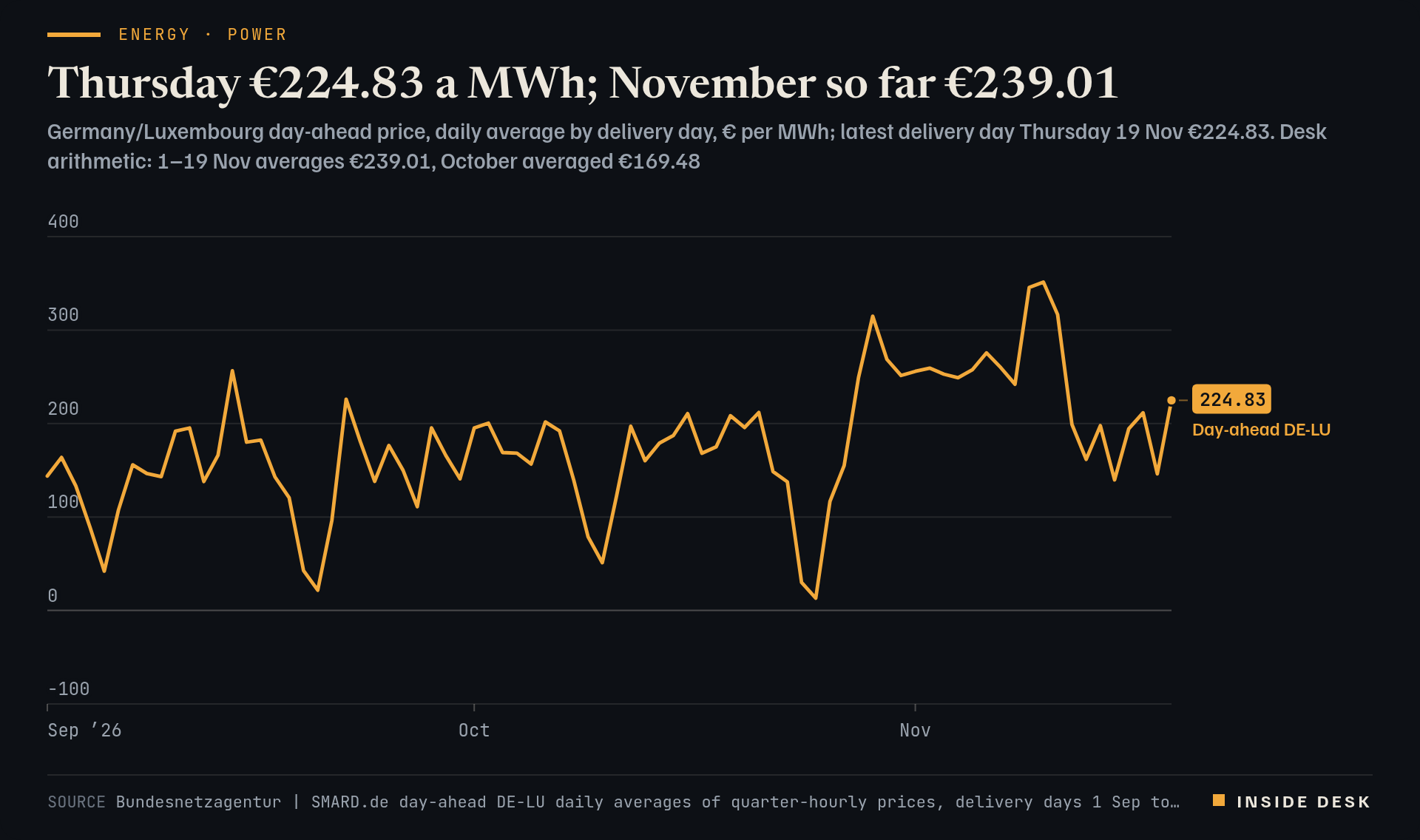
Line chart of the daily average German-Luxembourg day-ahead electricity price from 1 September to 19 November 2026, in euros per megawatt hour. Prices mostly ran between about €100 and €210 in September and October, climbed above €250 from late October, peaked at €351.48 on Tuesday 10 November, fell to €139.70 on Sunday 15 November and €146.25 on Wednesday 18 November, and stand at €224.83 for the latest delivery day, Thursday 19 November.
Source Bundesnetzagentur | SMARD.de day-ahead DE-LU daily averages of quarter-hourly prices, delivery days 1 Sep to 19 Nov 2026 (latest available: Thursday 19 Nov €224.83; no Friday prices published yet), retrieved 19 Nov 2026, 05:27 CET · CC BY 4.0. Bundesnetzagentur | SMARD.de, market data. CC BY 4.0.
Data (CSV) · SVG · PNG

Latest values as a table
| Date | Day-ahead DE-LU |
|---|---|
| 2026-11-14 | 197.72 |
| 2026-11-15 | 139.7 |
| 2026-11-16 | 194.49 |
| 2026-11-17 | 211.58 |
| 2026-11-18 | 146.25 |
| 2026-11-19 | 224.83 |
The other author
For delivery on Thursday, the German-Luxembourg day-ahead price averages €224.83 per megawatt hour across the day, according to SMARD, the Federal Network Agency’s data platform3. Inside that average the day has a shape you will recognise from your own kitchen. The cheapest quarter-hour came at 02:15, at €166.52; the dearest at 08:15, at €281.00, when the country is making coffee and starting machines3. The hour from 08:00 to 09:00 averaged €276.45, and every hour from 15:00 to 20:00 averaged above €2503.
Desk arithmetic: the 08:15 quarter-hour cost €114.48 per megawatt hour more than the 02:15 one. The first 19 delivery days of November average €239.01, against €169.48 for the whole of October, a rise of about 41%. Thursday sits below that November average; it is not a cheap day, merely a less expensive one than the record stretch around 10 November, when Tuesday averaged €351.483.
Your supplier buys ahead and smooths these quarter-hours into a tariff, which is why the averages matter: next spring’s tariff letter is being written now, in mornings like this one.
What the critics actually asked for
Read past the adjectives and the reactions converge on one dull demand: permanence. The consumer federation’s Ramona Pop called the cut an important first step that “must now be secured permanently as quickly as possible”2. The retailers’ association HDE warned that a one-year cut would simply fizzle out2. Monika Schnitzer, chair of the German Council of Economic Experts, said the time limit created “no planning certainty” and few incentives for long-term investment2. The SPD’s chief budget spokesman, Thorsten Rudolph, called the funding, a lower-than-expected bill for renewable-energy payments next year, “no permanent financing”2.
The defence came from North Rhine-Westphalia’s premier, Hendrik Wüst: Germany passes annual tax laws for a year at a time, “that is why they are called annual tax laws”2. Ifo’s Clemens Fuest called the cut economically well founded, because the tax “hampers electrification”2.
The contrarian point is that both camps are right about different clocks. A one-year cut is a fine invoice adjustment and a poor investment signal. Nobody installs a heat pump on the strength of a single tax year.
The fuel behind the price
Gas-fired plants set the marginal electricity price across much of the region6, and gas gave some help on Wednesday: the Dutch TTF benchmark closed at €81.11 per megawatt hour, down 5.03% on the day5. Oil was steady overnight. Brent traded at $92.12 a barrel at 03:37 CET, up 0.18%, after falling 1.3% on Wednesday; WTI was at $83.17, after a 3.2% drop to its lowest since 26 August4. Reuters attributes the slide to expectations of a supply surplus, with crude shipments through the Strait of Hormuz back to roughly pre-war levels, and to a larger-than-expected US stock build of 3.4 million barrels4. Iranian media reported on Wednesday that three tankers east of the strait were disabled by mines4, a reminder that “pre-war volumes” and “peace” are not the same word.
For you, the reading is modest: the tax cut is small and certain, the wholesale price large and unpriced until it is. Nothing here is investment advice.
What to watch
- Thursday around midday CET: the day-ahead auction sets Friday's German power prices; SMARD had none published at 05:27 CET3
- Whether the coalition names funding for the tax cut beyond 2027, the point consumer groups, the HDE and the Wirtschaftsweisen all pressed on Wednesday2
- Thursday's US–China–Russia summit in Shenzhen, which oil traders are watching for clues on the Iran war4
A tax is decided once a year; a price is decided every quarter of an hour. Budget for the second.
Sources
- Was Stromsteuersenkung und Spritpreisdeckel den Verbrauchern bringen — MDR Aktuell, 19 Nov 2026, 05:00 CET.
- "Kleiner Hüpfer", "überfällig", "abenteuerlich" - Reaktionen auf Stromsteuersenkung — tagesschau.de, 18 Nov 2026, 13:40 CET.
- Day-ahead prices DE-LU (quarter-hourly, delivery days to 19 Nov 2026) — Bundesnetzagentur | SMARD.de, retrieved 19 Nov 2026, 05:27 CET.
- Oil prices steady as supply surplus softens sentiment though Gulf war supports — Reuters via CNBC, 19 Nov 2026, 04:19 CET.
- TTF gas (EUR/MWh) daily close — Closelook, close of 18 Nov 2026.
- European gas falls below €85/MWh as US LNG output hits record — Balancing Energy, 18 Nov 2026.
Every figure in this piece traces to a source above or to the desk’s own arithmetic on those sources, marked as such. Quotations are short and attributed. Spot an error? Write to the desk; corrections are logged on the method page.
Commentary for information only. Not investment, legal, tax, medical or political advice. Not an offer or solicitation. Analysis may be incomplete or wrong. Charts show published public data, not a trading feed; binding numbers live with the institutions that publish them.