Inside DeskANYWHERE

Twice-daily brief for people who prefer incentives to applause.

Berlin time Support (keeps it free)
Morning edition · Tuesday, 17 November 2026 · 08:30 CET

Minus 1.2% in Tokyo, a rule for rented chips: Asia trades the week's paperwork

Asia sold off ahead of Nvidia's results tonight and a US rule printed overnight. Also: missiles on Kyiv's bridges, a roughly €7 billion evening bill in Berlin, COP31's 18-page draft, 669 GWh of wind for Tuesday and car liability cover 4% dearer for 2027.

Morning 08:30 · Evening 18:30 · Sunday 10:00, Berlin time

Read this edition as ePaper → PDF

MARKETS · LEAD Chart

Minus 1.2% in Tokyo, a licence rule in Washington: Asia trades the week's paperwork

Asia followed Monday's Wall Street fall, but the selling had two causes, not one: a company that reports tonight and a rule that was printed overnight. Only one of them is about the AI boom.

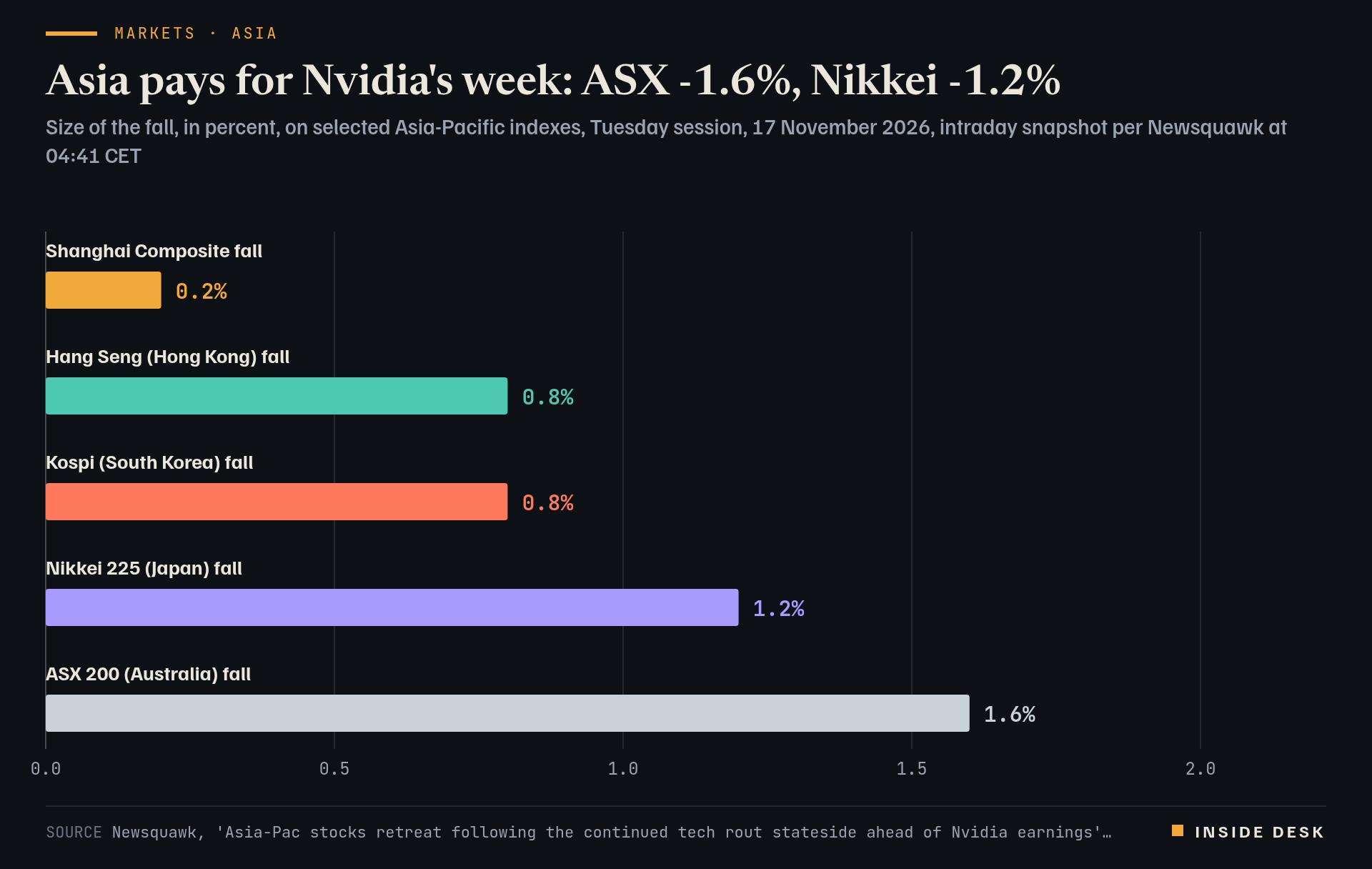
Asia opened Tuesday where Wall Street left it on Monday, which is to say lower. On Monday the S&P 500 lost about 1.9% and the Nasdaq Composite 2.5%, and a gauge of US chip stocks sank 5.3%. By 04:41 CET, Newsquawk had Australia's ASX 200 down 1.6%, Japan's Nikkei 225 down 1.2%, the Kospi and the Hang Seng each down 0.8% and the Shanghai Composite down 0.2%. These are intraday snapshots, not closes.

**The figures, with their times.** AFP's table at around 03:30 CET had the Nikkei down 1.2% at 58,956.67, the Kospi down 1.1% at 5,043.51, the Hang Seng down 1.3% at 23,457.40 and Shanghai down 0.7% at 3,576.57. Reuters reported the Kospi down 2% shortly after the open and Taiwan down 1.4%. The Kospi opened 1.81% lower at 5,008 and then regained some ground, RTHK reports, with Samsung Electronics down 2.41%. In Tokyo, Kioxia, Advantest and SoftBank were among the worst hit. Note how the numbers move between sources: a falling market is not one number but a series of them, each with a clock.

Markets & Macro · 3 min · Read the piece →

Desk notes

End of edition · added

Before you close the tab

One thing you can do this week

Once this week, write one card or letter by hand to someone who still has a letterbox: three sentences are enough. Address it, stamp it, and walk it to the postbox rather than leaving it on the hall table. The writing takes ten minutes; the walk is the part that makes it real.

A habit, not advice.

What went right

For the first time in more than a century, native oysters have been born in the Dornoch Firth in the Scottish Highlands, Heriot-Watt University reported on 16 November 1. The firth's oysters were probably fished to extinction in the late 1800s; the restoration began in 2017 with 300 oysters from Loch Ryan, and by October 2026 more than 140,000 hand-cleaned juveniles had been released by scientists and volunteers 1. Some of the new spat have already reached the size of a 50p coin 1. "This is a moment over 12 years and 140,000 oysters in the making," said Professor Bill Sanderson 1. The project now aims for around four million oysters by 2031 1. Twelve years of scrubbing shells is not a headline; it is a reef.

The day in one sentence

Tokyo slipped 1.2% after Wall Street, Washington printed a rule for rented chips, missiles went for the bridges people cross in Kyiv, and in Berlin and Antalya the day's real work is a bill and a draft, not a speech.

In euros at home

Deutsche Post plans to raise the price of a standard letter on 1 January from 95 cents to €1.15, and a postcard by the same amount; the Großbrief rises 55 cents to €2.35 and the Maxibrief €2.10 to €5 2. The regulator, the Bundesnetzagentur, allowed letter prices to rise by up to 20.35%, and the Post uses that frame in full; the final approval is still pending 23. The reason is volume: 16.9 billion letters were sent in Germany in 2005, barely 9.4 billion in 2025 2. Desk arithmetic: 20 cents more is a rise of 21.1%; a household sending 30 standard letters a year pays €6 more, and ten Großbriefe add €5.50. Desk arithmetic: the 2025 letter volume is about 44% below 2005, carried by the same network of postboxes and branches.

Prices as announced by Deutsche Post and reported by tagesschau on 20 Oct 2026, subject to final approval by the Bundesnetzagentur. Nothing here is advice.

Small words

Spat

The young of oysters and other shellfish once they have finished drifting in the plankton and settled, only a few millimetres across at first; finding spat is how restorers know a population is breeding, not just surviving 1.

Sources for this section

  1. First oysters born in Dornoch Firth for over 100 years — Heriot-Watt University, 16 Nov 2026
  2. Porto für Briefe wird wohl bald teurer — tagesschau.de, 20 Oct 2026, 16:00 CET
  3. Brief und Paket: Das ändert sich 2027 — Deutsche Post, 17 Nov 2026 (retrieved)

Commentary for information only. Not investment, legal, tax, medical or political advice. "Desk arithmetic" is our own calculation from the cited figures.

Charts and data in this edition