Sunday long-read · Sunday, 15 November 2026
The Sunday long read: Nvidia lost its founder and $657 billion. On Tuesday it sends the invoice
The week's AI story was told in share prices, scandal and a chief executive's exit. The story that will outlast it is written in revenue lines, prepayments, colocation dates and town-hall ballots, and the first of those documents arrives on Tuesday.
If you followed the technology pages this week, you followed a man. Jensen Huang, who co-founded Nvidia and led it for 33 years, resigned on Thursday after two extramarital affairs were made public, one with an alleged Chinese spy and one with an employee1. The board named the finance chief, Colette Kress, interim chief executive while it searches for a successor1. It was the kind of story that writes its own headlines, and it wrote a great many.
This Sunday is a good moment to put the man down and pick up the paperwork. Not because the scandal does not matter, but because the thing that the AI build-out actually runs on was never his biography. It runs on documents: order books, revenue lines, loan agreements, prepayments, permits and power contracts. Those had a busy week too, and almost nobody put them on a front page.
The price. Start with what the market did, because it is the loudest number. Nvidia’s shares fell 13% over the week, the most since April 2025, in a sixth straight weekly decline, the longest losing streak since 20121. Since the slide began in early October the company has lost 30% of its value, roughly $1.7 trillion of market capitalisation, and it has slipped behind Apple1. On Friday it closed at $162.85, below $4 trillion in market value, after shedding $657 billion in the week, Chip Dispatch reported2,3.
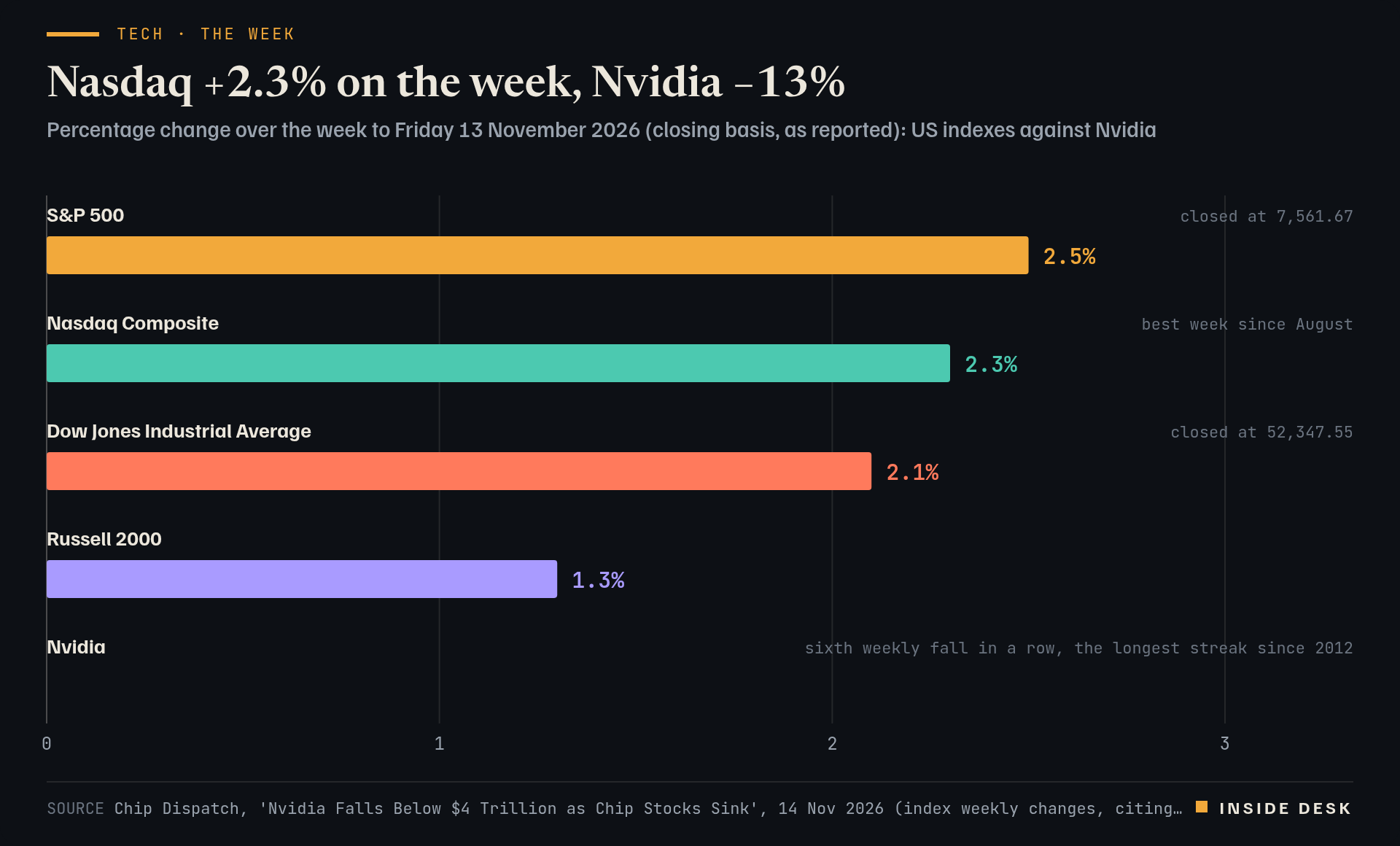
Now look at the chart, because the price of one company is not the price of the industry, and certainly not the price of the market.
Bar chart of percentage changes in the week to Friday 13 November 2026: S&P 500 up 2.5 percent, Nasdaq Composite up 2.3, Dow Jones up 2.1, Russell 2000 up 1.3, while Nvidia fell 13 percent in its sixth straight weekly decline, as reported by Chip Dispatch and CNBC.
Source Chip Dispatch, 'Nvidia Falls Below $4 Trillion as Chip Stocks Sink', 14 Nov 2026 (index weekly changes, citing the Associated Press for closes); CNBC, 'Nvidia stock suffers longest weekly losing streak since 2012', 13 Nov 2026 (Nvidia); retrieved 15 Nov 2026 · reported figures. Figures as reported by the named organisations; facts cited with attribution.
Data (CSV) · SVG · PNG

Latest values as a table
| Value | |
|---|---|
| S&P 500 | 2.5% |
| Nasdaq Composite | 2.3% |
| Dow Jones Industrial Average | 2.1% |
| Russell 2000 | 1.3% |
| Nvidia | -13% |
In the same week the S&P 500 gained 2.5%, the Nasdaq 2.3% (its best week since August), the Dow 2.1% and the Russell 2000 1.3%2. The money did not run from America’s companies. It ran from a particular kind of uncertainty, and much of it moved down the street. That is not a crash. It is a market doing what markets are for: repricing one risk without abandoning everything else.
It is also worth noting how the analysts spoke. “We believe the market has appropriately adjusted for this transition,” D.A. Davidson’s Gil Luria wrote, while cutting his price target to $200 from $3001. HSBC went further, cutting the stock to hold and its target to $170 from $365, on the view that the shares will struggle until a new chief executive is named2. Oppenheimer put the week’s mood in one sentence: “we expect fundamentals to take a backseat near term”1. Note the phrase “near term”. Fundamentals do not leave the car. They just stop driving for a while.
The invoice. On Tuesday 17 November Nvidia reports its third quarter1. Analysts project revenue of $108.9 billion, 91% more than a year earlier, according to LSEG figures cited by CNBC; that is eighteen times the same quarter of 2022, just before ChatGPT1. Some strategists, Yahoo Finance reported, point to a forward price-to-earnings ratio of 133.
Desk arithmetic: if the quarter lands at $108.9 billion, that is roughly $1.2 billion of revenue a day over a 91-day quarter.
That figure is not a forecast of ours; it is the analysts’ consensus, and consensus can be wrong in either direction. But it shows what kind of document Tuesday’s release is. It will not tell you who should run Nvidia. It will tell you how many data-centre racks were paid for between August and October, at what margin, and what the company expects customers to pay for next. A chief executive’s exit can change a share price in an afternoon. It cannot reach back and cancel a quarter’s shipments.
The financing. If you want the real stress in the system, do not look at Santa Clara. Look one step down the chain, at the companies that rent out the chips. CNBC reported the point plainly: Nvidia is “wildly profitable”, but big customers such as the neoclouds rely on the debt markets1. And the debt markets had a hard week. The US ten-year Treasury yield touched 5.17% on Friday, its highest since October, and Treasuries extended their worst week since April 20252.
Nebius, one of those neoclouds, reported its third quarter on Thursday, and its numbers are a small textbook. Revenue rose 571% to $981 million4. Capital spending rose 664% to $7.3 billion in the same quarter4. The company now expects about $27 billion of capital spending for 2026, above its earlier $20–25 billion range, and revenue at the low end of $3.0–3.4 billion4. Its first 2027 outlook is revenue of $12–13 billion and capital spending of $40–45 billion4.
Read those lines slowly and you see the shape of the whole build-out: spending runs ahead of revenue by a wide margin, on purpose, because capacity has to exist before it can be sold. The interesting part is how Nebius says it will pay. Prepayments on deals signed in the third quarter covered more than 100% of the related capital spending, up from 50–60% in the second; with loans backed by contracts with investment-grade customers, they should fund 75–85% of 2027 spending4. That is the dull machinery that matters: customers paying in advance, lenders lending against signed contracts. It is not hype. It is underwriting.
Its weakness was equally dull. The shortfall came from capacity at third-party sites that is now due in the first half of 2027; in New Jersey, it expects to deliver more than half of the capacity contracted with Microsoft by the end of the year and the rest in the second quarter of 20274. The contracts behind the delayed capacity remain in place, the company says4. The shares still fell; Chip Dispatch reported Nebius down nearly 17% at one point on Friday2. A delay is not a cancellation. But in a market paying 5% for ten-year money, two months is a cost.
The permit. Then there is the constraint no balance sheet can solve. On 3 November, voters favoured limiting data-centre development in 40 of 41 local ballot measures, Ballotpedia counted, including five full bans and twelve partial bans5. One Ohio measure requires a public vote for developments using more than 20 megawatts of electricity or 500,000 gallons of water a day5. CNBC noted that the election results and ballot measures “could slow the artificial intelligence buildout”1. You can raise a billion dollars in a morning. You cannot raise a substation without the town.
And notice where the money went when it left the chip makers. Modine, a maker of data-centre cooling equipment, rose more than 25% on a report that Samsung is in talks to buy it2. The market’s instinct, even in a bad week, was to buy the plumbing.
What the week argues. Three things, none of them exciting.
First, a company is not its founder, and a market is not its biggest stock. The chart above is the useful corrective: one line red, the rest green1,2.
Second, the real test of the AI build-out is not a share price but a sequence of documents with dates on them: Tuesday’s revenue line, the prepayments behind each new data hall, the colocation dates that slip from December to the second quarter, and the ballot that decides whether a site may draw 20 megawatts at all1,4,5. Each of those can be checked. None of them can be wished into existence by a keynote.
Third, if you own a world index fund, this was a week in which concentration hurt and diversification worked, both visibly. If you work in technology, it was a lesson in governance as an operating system: a board that can name an interim chief overnight is doing its job1. And if you simply use these tools, nothing you rely on stopped working because a man left a building.
So on Tuesday evening, when the headlines ask whether Nvidia is “back”, ask something smaller. How much was invoiced, how much was paid in advance, and how much capacity is waiting for a permit or a power line? Those three answers will tell you more about the next year than any successor’s first speech. Nothing here is investment advice.
What to watch
- Nvidia's third-quarter results on Tuesday 17 November, its first report under interim chief executive Colette Kress; analysts expect revenue of $108.9 billion, according to LSEG via CNBC1.
- Anthropic's IPO next week, after bankers weighed pricing above the $70–78 range, per the Financial Times as reported by Chip Dispatch2.
- Two local data-centre ballot measures in Clarksville, Arkansas, and one in Mandan, North Dakota, in December5.
A share price is an opinion about the future. An invoice is a fact about the past. Weeks like this one are when you learn which of the two you were holding.
Sources
- Nvidia stock suffers longest weekly losing streak since 2012 as market value sinks by $1.7 trillion — CNBC, 13 Nov 2026, updated 23:18 CET.
- Nvidia Falls Below $4 Trillion as Chip Stocks Sink Mixed Wall Street Close — Chip Dispatch, 14 Nov 2026.
- Nvidia stock slips as investors digest CEO exit, broader chip sell-off accelerates — Yahoo Finance, 13 Nov 2026, 22:04 CET.
- Nebius beats Q3 revenue estimates, shares fall as data center delays weigh on 2026 outlook — Stock Analysis, 12 Nov 2026, 14:31 CET.
- Voters favored limiting data center development in 40 of 41 local ballot measures on Nov. 3 — Ballotpedia News, 6 Nov 2026.
Every figure in this piece traces to a source above or to the desk’s own arithmetic on those sources, marked as such. Quotations are short and attributed. Spot an error? Write to the desk; corrections are logged on the method page.
Commentary for information only. Not investment, legal, tax, medical or political advice. Not an offer or solicitation. Analysis may be incomplete or wrong. Charts show published public data, not a trading feed; binding numbers live with the institutions that publish them.